-100
%
CHEMICALS
-70
%
Co2
-45
%
Water
3
jaar
ROI
Terug naar overzicht
With operations in approximately one hundred countries worldwide, Amgen upholds high standards in quality, reliability, and process assurance. The same standards apply to the technical installations at its sites.
CHEMICALS
Co2
Water
ROI
Within Amgen, Pathema’s technology is regarded as a new standard in cooling water treatment.

Amgen is an international biotechnology company that has been developing innovative medicines for patients with serious illnesses since 1980. With operations in approximately one hundred countries worldwide, Amgen upholds high standards in quality, reliability, and process assurance. The same standards apply to the technical installations at its sites.
Pathema shares this focus on innovation and quality and is proud to count Amgen among its clients.
Context: water and energy in California
In California, a large share of commercial building cooling is provided by water cooled systems. In 2012, an estimated 6,985 GWh of cooling was delivered through water cooled installations, representing approximately 35 percent of the state’s total cooling demand. At the same time, an estimated 3.9 billion liters of drinking water are used annually in cooling towers, excluding evaporation losses and chemical discharge.
Given California’s structural drought conditions, this presents a serious challenge for water availability and water treatment. For this reason, the California Energy Commission actively stimulates investment in water innovation. The objective is to accelerate the demonstration and implementation of sustainable technologies that are scalable for the future.
Within this program, Pathema’s Vortex Process Technology was selected. The technology stood out among 28 submitted solutions based on a successful field evaluation. The installation at Amgen was established as a pilot project within the service area of the California Energy Commission.
Operational evaluation
At Amgen, an IVG20 C NANO12 Pro cooling water treatment system was installed in a 20 ft container. Over a period of twelve months, the installation was evaluated on water consumption, energy efficiency, and heat transfer performance of chillers and cooling towers.
The performance assessment was positive. Of the 49 predefined targets, 47 were achieved. Analysis showed that the system delivered the expected energy savings, with an estimated reduction of approximately 7 percent as a result of degassing of the cooling water. This led to improved heat transfer and lower water viscosity.
In addition, it was demonstrated that chemicals were no longer required to control and recycle process and cooling water. By operating at higher and more controlled cycles of concentration, overall water consumption was reduced. Blowdown from the cooling towers remained completely chemical free and could be recycled as non evaporated cooling water.
Results and new standard
Based on the monitored data, the system showed a phased reduction in water consumption, with an average cycle of concentration of approximately 7.8. A comparison of data before and after the first six months indicates a water saving of around 15 percent based on the available measurements.
Dosing of chemicals for scale control, corrosion inhibition, and microbiological growth was fully discontinued. As a result, the blowdown water became 100 percent chemical free.
After twelve months, the installation was formally transferred to Amgen by the California Energy Commission. Within Amgen, Pathema’s technology is regarded as a new standard in cooling water treatment. Several additional installations are planned for the future.
Conclusion
This case demonstrates how chemical free cooling water treatment has been successfully validated under real operating conditions at an international pharmaceutical company. By combining water savings, energy efficiency, and process assurance in one integrated solution, Pathema contributes to sustainable innovation in one of the world’s most demanding industries.
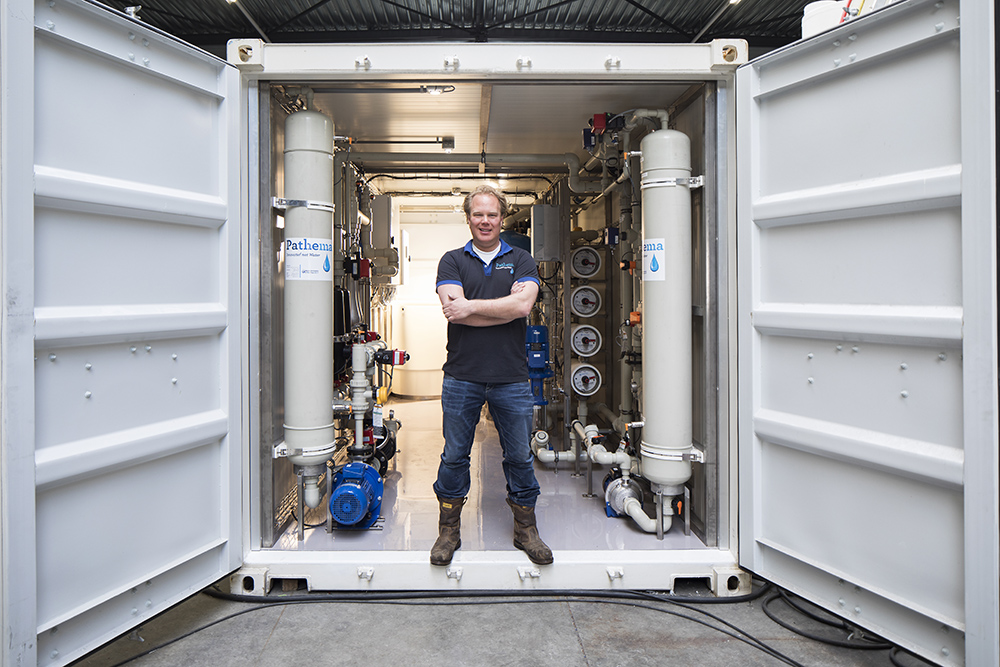
Mark Boeren, CEO of Pathema, in front of the installation at Amgen